
What Air Conditioning Repair Covers
Your vehicle’s air conditioning system does more than keep passengers comfortable during humid summers—it also dehumidifies cabin air rapidly when running the front windshield defroster during rainstorms and winter slush. Because automotive AC operates as a sealed, pressurized refrigeration loop, refrigerant is not consumed during normal use.
If your vents blow warm air, cool only on the highway but turn lukewarm at traffic lights, or cycle inconsistently, simply adding an off-the-shelf recharge can from a retail store rarely solves the root issue and often overcharges the system or introduces sealants that clog expansion valves and shop recovery machines.
Professional air conditioning diagnostics measures both high-side and low-side system pressures, verifies radiator cooling fan operation, inspects blend doors and cabin air filters, pinpoints leaks using electronic sniffers or UV dye, evacuates moisture under deep vacuum, and weighs in the exact gram specification of R-134a or newer R-1234yf refrigerant.
Common Problems Addressed
Refrigerant Leaks at O-Rings, Condenser, or Shaft Seals
Road debris striking the front AC condenser behind the grille, aged rubber O-rings, or leaking service port Schrader valves gradually allow refrigerant charge to drop until the low-pressure switch disables the compressor.
Warm Air at Idle, Cold Air at Highway Speed
This classic symptom frequently points to an inoperative electric radiator/condenser cooling fan, debris blocking condenser fins, or a slightly low refrigerant charge.
Weak Airflow & Musty Odors from Vents
A severely clogged cabin air filter restricts blower volume, while damp debris and mildew growing on the dark evaporator core behind the dash create stale odors—especially when the condensate drain tube plugs up.
Warm Air on One Side Only (Dual-Zone Blend Door Actuator)
Clicking noises behind the dashboard accompanied by cold air on the driver side and warm air on the passenger side commonly indicate a stripped plastic blend door actuator gear or low charge.

Standard Service Process
Step 01: Cabin Airflow, Vent Temperature & Filter Check
Measure center vent outlet temperature against ambient humidity, inspect the cabin air filter, verify blower speeds, and test hot/cold blend door response.
Step 02: Cooling Fan, Compressor Clutch & Electrical Verification
Confirm the AC compressor clutch or variable-displacement control valve engages properly and that radiator/condenser fans ramp up immediately when AC is commanded on.
Step 03: Manifold Pressure Analysis & Refrigerant Identification
Verify whether the vehicle uses R-134a or R-1234yf (per the under-hood label), check high/low pressures, and test for contaminated refrigerant or aftermarket stop-leak sealants.
Step 04: Leak Pinpointing, Component Repair & Deep Vacuum
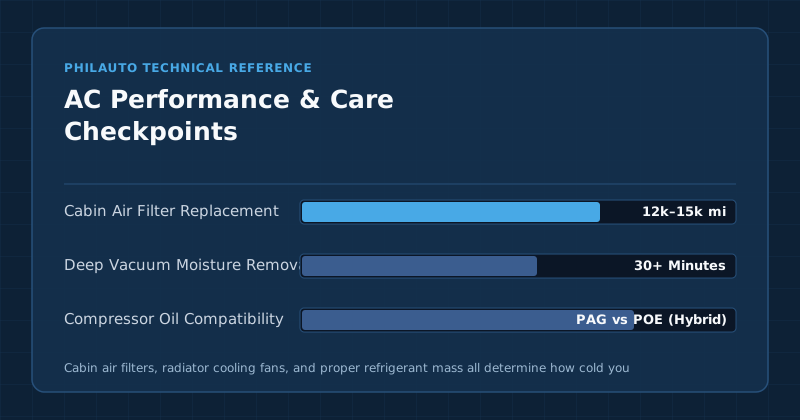
Locate leaks using UV tracer dye, electronic leak detection, or nitrogen pressure testing; replace faulty O-rings, hoses, or condenser; then pull a deep vacuum for 30+ minutes to boil out moisture and confirm vacuum holds.
Step 05: Precision Mass Recharge & Final Performance Test
Charge refrigerant strictly by OEM weight (ounces/grams) using EPA Section 609-certified recovery equipment and confirm crisp vent temperatures at idle and road speed.
| Standard | Typical Model Years | Key Service Note |
|---|---|---|
| R-134a | 1994–approx. 2018–2021 | Uses dedicated fittings; PAG oil for belt-driven compressors |
| R-1234yf | Most 2018+ US vehicles | Lower global warming potential; mildly flammable (A2L); requires dedicated machine |
| Hybrid / EV Compressors | All HEV / PHEV / BEV models | Requires non-conductive POE oil—never mix with standard PAG oil |
Benefits
- Restores rapid summer cabin cooling and dependable wet-weather windshield defogging.
- Protects the expensive AC compressor from seizing due to low refrigerant/oil circulation.
- Eliminates guesswork and prevents system damage caused by overcharging or stop-leak additives.
- Complies with US EPA environmental regulations prohibiting venting refrigerant into the atmosphere.
When to Seek Professional Assistance
- Air from the vents is barely cool or completely warm even on Max AC.
- You hear loud rattling, squealing, or grinding from the front of the engine when pressing the AC button.
- Water pools on the passenger-side floor carpet (usually a clogged AC evaporator drain hose).
- Your vehicle uses R-1234yf refrigerant or is a hybrid/electric vehicle with a high-voltage electric AC compressor requiring non-conductive POE oil.
Important Safety Information
- Under US EPA Clean Air Act Section 609 rules, deliberately venting automotive refrigerants into the air is illegal; refrigerant must be captured with certified recovery equipment.
- Liquid refrigerant causes instant frostbite on bare skin and severe eye injury—always wear safety goggles and gloves around pressurized service ports.
- Hybrid and electric vehicles use high-voltage (300V–800V) electric AC compressors that require electrically non-conductive POE lubricant; introducing standard conductive PAG oil from a DIY recharge kit can trigger dangerous high-voltage isolation faults.
Frequently Asked Questions
Should I run my car’s air conditioning briefly during winter months?
Yes. Running the AC or windshield defroster for 5 to 10 minutes once every couple of weeks during winter circulates refrigerant and lubricant across compressor shaft seals and O-rings, helping prevent them from drying out and leaking by spring.
Are DIY AC recharge cans with "stop-leak" safe to use?
Most professional technicians strongly advise against stop-leak additives. Those polymers react with moisture and air to harden—meaning they can clog narrow expansion valves, micro-channel condensers, and damage professional recovery machines, turning a minor O-ring fix into a full system replacement.
Why does water drip underneath my car after running the AC on a humid day?
Clear, odorless water dripping under the passenger-side firewall is completely normal. As warm, humid air passes across the cold AC evaporator core, moisture condenses and drains harmlessly onto the ground through the condensate tube.