What Battery Testing Covers
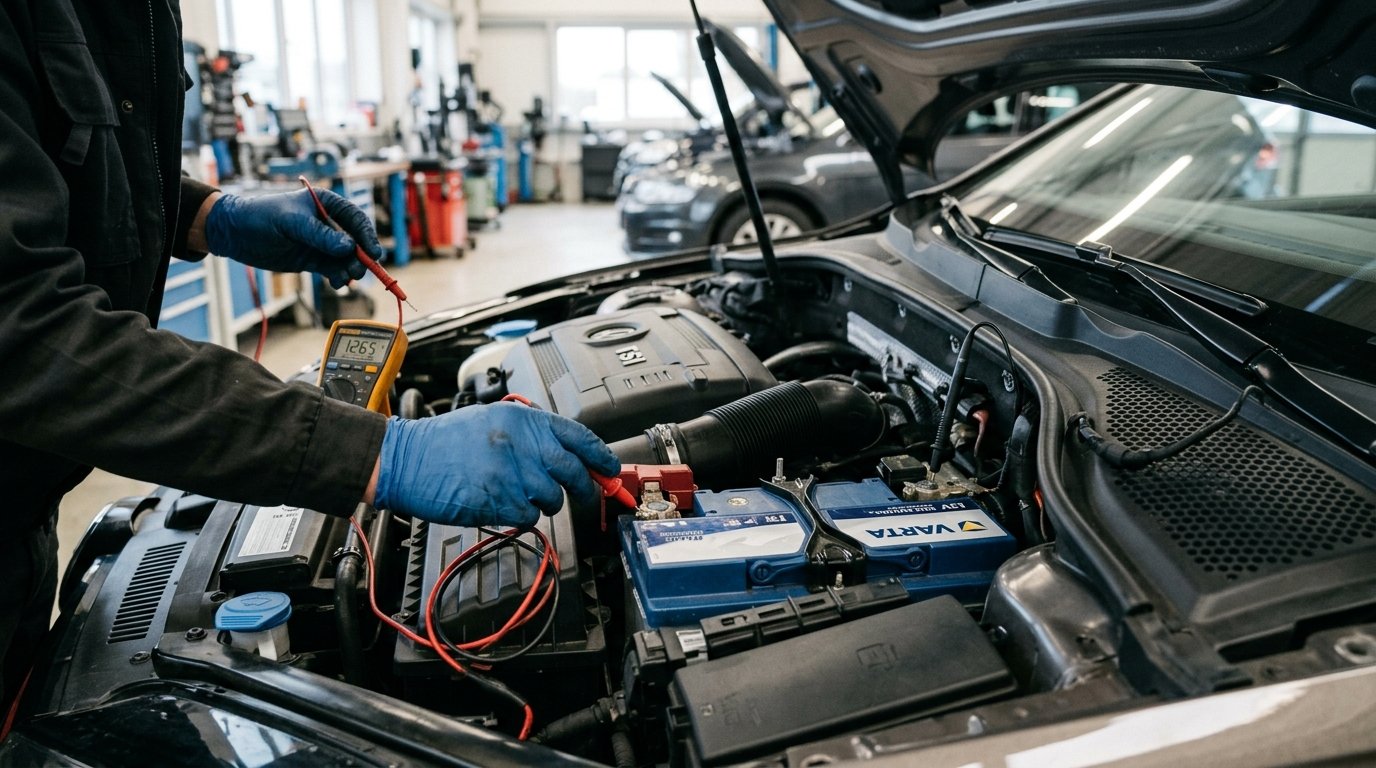
A dead car battery rarely happens out of nowhere—it usually develops gradually over months of heat stress, short trips, and internal plate sulfation until the first freezing morning or scorching afternoon pushes it past its limit. Proactive battery testing takes less than ten minutes and measures actual Cold Cranking Amps (CCA) capacity before you are stranded in a parking lot.
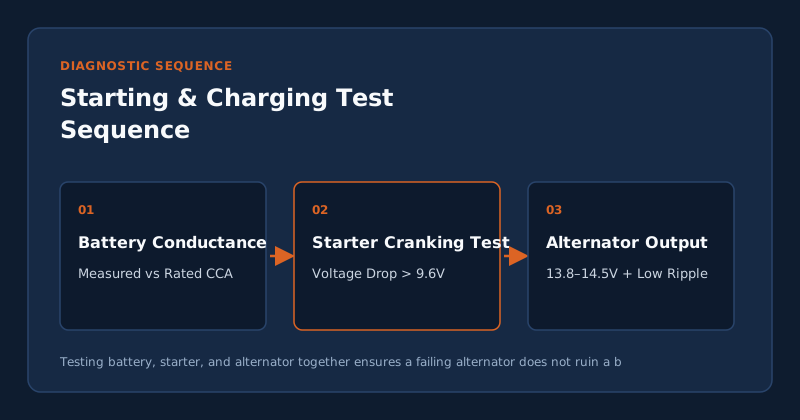
Checking voltage alone with a simple voltmeter does not tell the whole story. A dying battery can still display 12.5 volts with no load, yet collapse below 8 volts the moment you turn the key or press the start button. Proper battery testing uses a digital conductance tester or carbon-pile load tester alongside a starter cranking drop test and an alternator charging/ripple test.
Even electric vehicles (EVs) and hybrids rely on a standard 12-volt auxiliary battery to boot onboard computers, engage high-voltage contactors, and power locks and hazard lights—making 12-volt battery health essential for virtually every vehicle on US roads.
Common Problems Addressed
Heat-Accelerated Internal Degradation & Winter Failure
Extreme summer engine-bay heat (especially in Southern and Southwestern US states) evaporates electrolyte and corrodes lead plates; winter cold then thickens engine oil and exposes the weakened capacity.
Corroded Terminals & Loose Ground Straps
White, green, or bluish powdery corrosion around battery posts introduces high electrical resistance, mimicking a dead battery or preventing the alternator from fully recharging the battery.
Alternator Undercharging or Diode Ripple Failure
Replacing a dead battery without verifying alternator output often results in another dead battery within days if the alternator is failing to deliver 13.8–14.5 volts under electrical load.
Parasitic Battery Drain Overnight
A malfunctioning trunk light switch, aftermarket dashcam wired improperly, or a control module failing to enter sleep mode can quietly drain a healthy battery over 24 to 48 hours parked.

Standard Service Process
Step 01: Date Code, Case & Terminal Inspection
Verify the battery’s manufacturing date sticker, check the plastic case for bulging or acid seepage, confirm secure hold-down clamping, and inspect terminal clamps and ground cables.
Step 02: Open-Circuit Voltage & Conductance / CCA Test
Remove surface charge if recently driven, enter the battery’s rated CCA and type (flooded lead-acid, EFB, or AGM), and measure remaining cranking capacity percentage.
Step 03: Starter Cranking Voltage Drop Test
Monitor minimum battery voltage while cranking the engine (healthy systems generally stay above 9.6–10.0 volts at room temperature).
Step 04: Alternator Loaded Output & AC Ripple Check
Test charging voltage at idle and ~2,000 RPM with headlights, HVAC blower, and rear defroster turned on, checking for excessive AC voltage ripple that indicates failing alternator diodes.
Step 05: Battery Registration & Memory Preservation (If Replaced)
On modern vehicles with Battery Management Systems (BMS), register the new battery type and capacity via a scan tool so the alternator adjusts its charging profile properly.
| Battery Type | Common Vehicles | Recommended Testing Schedule |
|---|---|---|
| Standard Flooded Lead-Acid | Traditional sedans, trucks, SUVs | Test twice yearly (spring & fall) after year 2 |
| EFB (Enhanced Flooded) | Entry start-stop vehicles | Test before winter/summer; replace only with EFB or AGM |
| AGM (Absorbent Glass Mat) | Start-stop, luxury, high-tech SUVs | Test annually after year 3; requires AGM-compatible charger |
| EV / Hybrid 12V Auxiliary | BEVs & Hybrids (separate from HV pack) | Test every 12 months; low 12V prevents vehicle boot-up |
Benefits
- Prevents unexpected no-start breakdowns before peak summer heat or winter cold snaps.
- Confirms whether the fault is the battery, alternator, starter motor, or a corroded cable before buying parts.
- Protects sensitive vehicle electronics from low-voltage glitches and alternator voltage spikes.
- Extends replacement battery life through proper AGM/EFB matching and BMS registration.
When to Seek Professional Assistance
- Your engine cranks sluggishly or hesitates for a second longer than usual on cold mornings.
- Your battery is more than 3 years old (in hot climates) or 4–5 years old (in moderate climates) and has not been load-tested.
- The red battery/charging warning light flickers or stays lit while driving.
- You needed a jump-start twice within a short period without leaving lights on.
Important Safety Information
- Lead-acid automotive batteries contain corrosive sulfuric acid and can emit explosive hydrogen gas during charging—wear eye protection and keep sparks, open flames, and cigarettes away.
- When disconnecting a 12V battery, always disconnect the NEGATIVE (-) black terminal first and reconnect it last to prevent accidental tool short-circuits against the metal chassis.
- If a battery smells strongly of rotten eggs (sulfur) or feels hot and swollen, shut off the engine immediately and have it inspected safely—it may be overcharging.
Frequently Asked Questions
Can I replace an AGM battery with a cheaper standard flooded battery?
No. Vehicles equipped from the factory with an AGM battery use higher charging voltages, deep-cycling start-stop profiles, or cabin/trunk venting assumptions tailored to AGM construction. Downgrading to a flooded battery causes premature failure and potential electrical faults.
How long should I drive after a jump-start to recharge a dead battery?
Driving for 30 to 45 minutes at steady highway speeds helps restore partial charge, but an alternator is designed to maintain a charged battery—not repeatedly deep-charge a flat one. Using a dedicated smart battery charger overnight is much healthier for both battery and alternator.
What does a rapid clicking noise when turning the key mean?
Rapid machine-gun clicking typically indicates the battery lacks sufficient cranking amperage (or has corroded terminals) to keep the starter solenoid engaged. A single loud click with strong headlights more often points to a failing starter motor or solenoid.